
Default
Can tower farms solutions help solve global food shortages?
With the global population projected to surpass 9.7 billion by 2050, traditional flat agriculture is facing the dual pressures of arable land depletion and intensifying climate change. At this juncture, tower farms, growing upwards like vertical forests, are being propelled to the forefront of addressing global food security challenges due to their revolutionary production parameters. Their core value lies first and foremost in extreme resource conservation: through closed-loop hydroponics or aeroponic systems, these facilities can save up to 95% of agricultural water, a crucial figure highlighted in the UN Food and Agriculture Organization's report emphasizing that agriculture consumes 70% of the world's freshwater resources. Simultaneously, precisely delivered nutrient solutions can improve fertilizer use efficiency by 70% and completely eliminate pesticide runoff, which is of paramount importance for protecting the 40% of arable land ecosystems globally that are facing degradation.
Space utilization efficiency is another disruptive advantage of tower farms solutions. For example, Plenty, a US-based vertical farming company, achieves 350 times the yield per unit area of traditional fields in its indoor farms, while shortening the growing season to only one-third of the traditional time. In Dubai, Bustanica, the world's largest vertical farm, built with the backing of an aviation giant, produces over 1 million kilograms of leafy greens annually while using 99% less water than outdoor farming. This model, shifting agricultural production from "horizontal expansion" to "vertical stacking," makes it possible to produce the same or even more food on land that accounts for only 1% of traditional agriculture, providing a practical path to food self-sufficiency in urbanized and desertified areas.
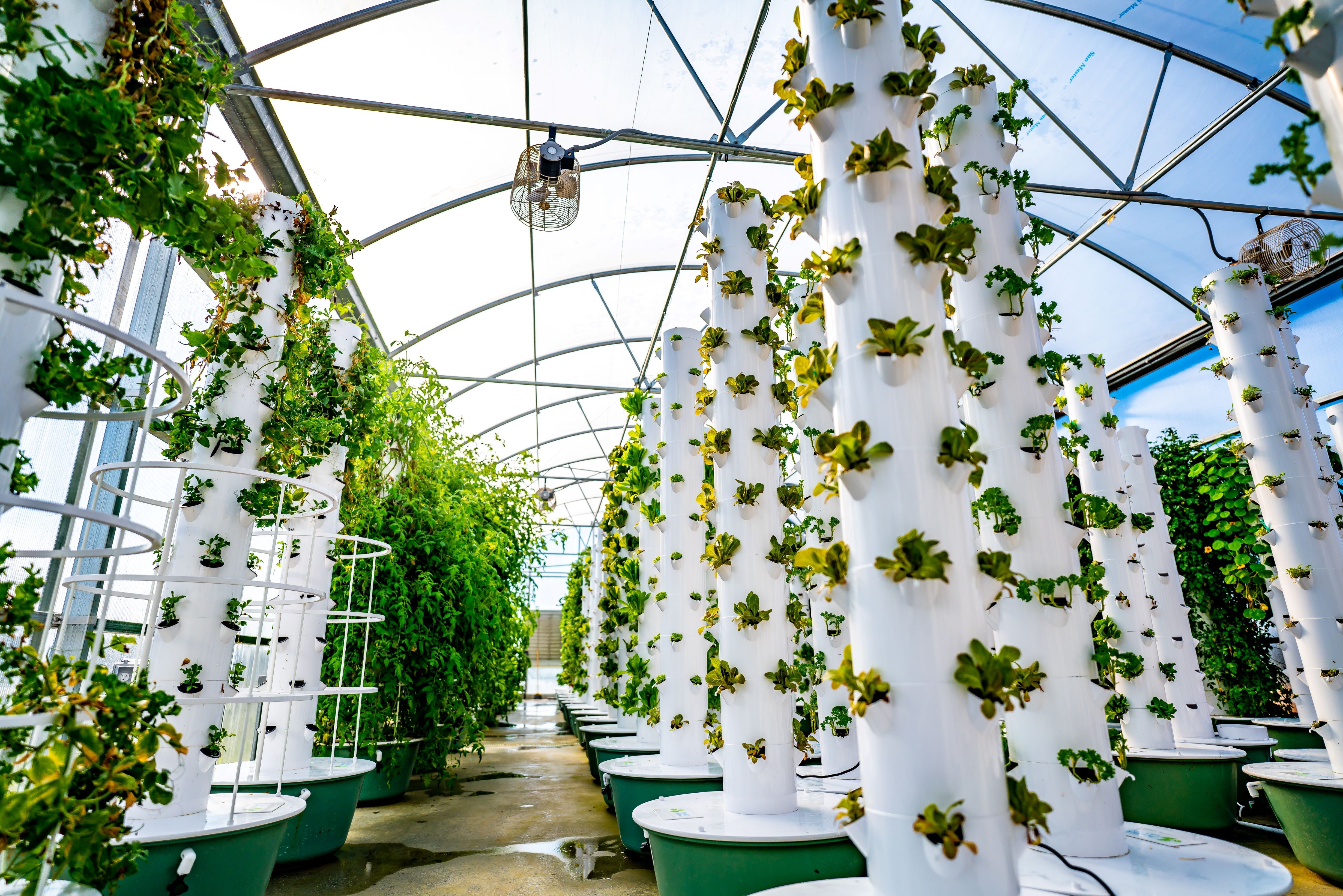 Vertical agriculture demonstrates strong resilience and stability in enhancing supply chain stability. By precisely controlling light, temperature (fluctuating within ±0.5°C), humidity, and carbon dioxide concentration (typically optimized to 800-1200 ppm), production is completely freed from the constraints of relying on weather conditions. Studies show that under controlled conditions, the annual harvest frequency can be stabilized at 20-30 crops, with yield fluctuations below 5%, a stark contrast to the over 30% yield fluctuations that can occur in traditional agriculture affected by floods and droughts. For example, in Miyagi Prefecture, Japan, after the 2011 tsunami caused severe salinization of farmland, vertical farming facilities played a crucial role in post-disaster food supply, demonstrating their unique value in responding to natural disaster crises.
However, objectively assessing their potential to address global food shortages requires acknowledging the challenges and costs they face. Currently, energy consumption, particularly LED lighting systems used to simulate sunlight, accounts for approximately 30-40% of the operating costs of vertical farms. Although technological advancements have reduced energy consumption per gram of plant growth by about 30%, the cost of electricity remains high for large-scale application to staple crops such as wheat and rice. A life-cycle analysis indicates that, with current technology, the carbon emissions for producing one kilogram of vertically farmed lettuce may be about 50% higher than in a traditional greenhouse, highlighting the urgency of integrating them with renewable energy sources such as solar power. In terms of initial investment, the start-up budget for a medium-sized commercial project typically ranges from $2 million to $10 million, with an average payback period of 5 to 10 years, limiting their rapid adoption in developing countries.
In conclusion, tower farms solutions are not intended to completely replace vast fields, but rather to serve as a crucial complement and innovation to the global food system. They are best suited for producing high-value, perishable leafy greens and herbs, and can significantly alleviate the "food mileage" problem in urban areas. Their true strategic significance lies in providing a proven technological blueprint and quantifiable data models for building a more resilient, efficient, and localized food production network in a future characterized by limited arable land, water scarcity, and climate instability. As the cost of renewable energy continues to decline and automation technologies further mature, this agricultural innovation will play an increasingly irreplaceable role in alleviating food shortages at specific regional and level levels.
Vertical agriculture demonstrates strong resilience and stability in enhancing supply chain stability. By precisely controlling light, temperature (fluctuating within ±0.5°C), humidity, and carbon dioxide concentration (typically optimized to 800-1200 ppm), production is completely freed from the constraints of relying on weather conditions. Studies show that under controlled conditions, the annual harvest frequency can be stabilized at 20-30 crops, with yield fluctuations below 5%, a stark contrast to the over 30% yield fluctuations that can occur in traditional agriculture affected by floods and droughts. For example, in Miyagi Prefecture, Japan, after the 2011 tsunami caused severe salinization of farmland, vertical farming facilities played a crucial role in post-disaster food supply, demonstrating their unique value in responding to natural disaster crises.
However, objectively assessing their potential to address global food shortages requires acknowledging the challenges and costs they face. Currently, energy consumption, particularly LED lighting systems used to simulate sunlight, accounts for approximately 30-40% of the operating costs of vertical farms. Although technological advancements have reduced energy consumption per gram of plant growth by about 30%, the cost of electricity remains high for large-scale application to staple crops such as wheat and rice. A life-cycle analysis indicates that, with current technology, the carbon emissions for producing one kilogram of vertically farmed lettuce may be about 50% higher than in a traditional greenhouse, highlighting the urgency of integrating them with renewable energy sources such as solar power. In terms of initial investment, the start-up budget for a medium-sized commercial project typically ranges from $2 million to $10 million, with an average payback period of 5 to 10 years, limiting their rapid adoption in developing countries.
In conclusion, tower farms solutions are not intended to completely replace vast fields, but rather to serve as a crucial complement and innovation to the global food system. They are best suited for producing high-value, perishable leafy greens and herbs, and can significantly alleviate the "food mileage" problem in urban areas. Their true strategic significance lies in providing a proven technological blueprint and quantifiable data models for building a more resilient, efficient, and localized food production network in a future characterized by limited arable land, water scarcity, and climate instability. As the cost of renewable energy continues to decline and automation technologies further mature, this agricultural innovation will play an increasingly irreplaceable role in alleviating food shortages at specific regional and level levels.
Vertical agriculture demonstrates strong resilience and stability in enhancing supply chain stability. By precisely controlling light, temperature (fluctuating within ±0.5°C), humidity, and carbon dioxide concentration (typically optimized to 800-1200 ppm), production is completely freed from the constraints of relying on weather conditions. Studies show that under controlled conditions, the annual harvest frequency can be stabilized at 20-30 crops, with yield fluctuations below 5%, a stark contrast to the over 30% yield fluctuations that can occur in traditional agriculture affected by floods and droughts. For example, in Miyagi Prefecture, Japan, after the 2011 tsunami caused severe salinization of farmland, vertical farming facilities played a crucial role in post-disaster food supply, demonstrating their unique value in responding to natural disaster crises.
However, objectively assessing their potential to address global food shortages requires acknowledging the challenges and costs they face. Currently, energy consumption, particularly LED lighting systems used to simulate sunlight, accounts for approximately 30-40% of the operating costs of vertical farms. Although technological advancements have reduced energy consumption per gram of plant growth by about 30%, the cost of electricity remains high for large-scale application to staple crops such as wheat and rice. A life-cycle analysis indicates that, with current technology, the carbon emissions for producing one kilogram of vertically farmed lettuce may be about 50% higher than in a traditional greenhouse, highlighting the urgency of integrating them with renewable energy sources such as solar power. In terms of initial investment, the start-up budget for a medium-sized commercial project typically ranges from $2 million to $10 million, with an average payback period of 5 to 10 years, limiting their rapid adoption in developing countries.
In conclusion, tower farms solutions are not intended to completely replace vast fields, but rather to serve as a crucial complement and innovation to the global food system. They are best suited for producing high-value, perishable leafy greens and herbs, and can significantly alleviate the "food mileage" problem in urban areas. Their true strategic significance lies in providing a proven technological blueprint and quantifiable data models for building a more resilient, efficient, and localized food production network in a future characterized by limited arable land, water scarcity, and climate instability. As the cost of renewable energy continues to decline and automation technologies further mature, this agricultural innovation will play an increasingly irreplaceable role in alleviating food shortages at specific regional and level levels.See your operation on a single map.
Book a 30-minute working session with a Where-I engineer. We'll model your catchment live, on your data.